

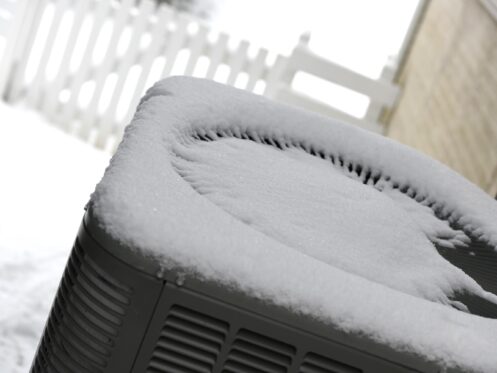
If you thought heat pumps only worked well in warm climates, we have some good news for you. For homeowners interested in something other than the traditional furnace, a cold-climate heat pump in Michigan offers a solution. They can lower your home’s energy consumption without sacrificing comfort, even when the coldest temperatures arrive.
At Great Dane Heating and Air Conditioning, we help homeowners understand how these heating systems work. We take the time to answer your questions so you feel confident in the purchase of your new heating system. Below, we go into more depth about how cold-climate heat pumps work, the myths surrounding them, their limits, and when they shine.
Performance at Low Temperatures
You’ve probably heard that heat pumps can’t work when the temperature drops below freezing. While this might have been largely true for older models, it isn’t true for inverter-driven cold-climate units. These systems are designed to maintain a high percentage of their rated heating capacity well below 0 degrees Fahrenheit, with many models efficiently extracting heat from the air down to temperatures as low as -15 degrees. While efficiency naturally decreases as the temperature differential increases, a cold-climate heat pump in Michigan has the capability of providing clean, energy-efficient heat for 95% of the Michigan heating season.
Backup Heat and Dual-Fuel
While cold-climate heat pumps offer impressive low-temperature performance, in periods of extreme cold, the heat pump’s output simply cannot keep up with a home’s heat loss. At this point, strategic backup heat is necessary. A dual-fuel system can help you keep your home warm during periods of extreme cold.
So, what is a system for dual-fuel in Michigan? To put it as simply as possible, a dual-fuel system pairs a high-efficiency heat pump with a traditional gas furnace. When the outdoor temperature drops below a user-defined set point, often between 10 and 25 degrees, the system’s smart thermostat automatically shuts off the heat pump and switches to the furnace.
This strategy offers efficiency and reliability. The heat pump handles the mild-to-cold temperatures when it is most efficient and cost-effective. Conversely, the furnace provides the high-BTU, high-temperature heat needed during prolonged periods of cold weather, ensuring the home stays warm.
In homes without natural gas, the heat pump relies on electric resistance heat as a backup. While less efficient than gas, this still provides reliable emergency heat and prevents the heat pump from running inefficiently or being overworked. For the majority of Michigan homeowners, a dual-fuel setup offers outstanding energy savings.
Understanding the Defrost Cycle
Have you seen a cold-climate heat pump periodically steaming or shutting down briefly? Don’t assume the pump isn’t working. Actually, it’s working hard and doing what it’s meant to do, which is entering the defrost cycle, a normal function.
You see, when the outdoor unit operates in heating mode in cold, humid conditions, moisture in the air freezes onto the outdoor coil. A layer of frost forms, acting as an insulator, which reduces the system’s ability to absorb heat from the air.
To correct this, the system initiates a defrost cycle. The flow of refrigerant temporarily reverses and essentially puts the unit into a brief cooling mode, sending hot refrigerant through the outdoor coil to melt the frost. The unit’s fan shuts off to prevent blowing cold air, and the auxiliary heat kicks in briefly to offset the cooling effect indoors. A defrost cycle typically lasts less than 15 minutes.
Heat Pump vs. Furnace in Detroit
Investing in a new heating system isn’t always a cut-and-dried decision. Homeowners often find themselves trying to decide between a heat pump and a furnace. The right system for your house depends on your heating goals.
If you want a single system that has the highest BTU output for the coldest weeks of the year, you can’t go wrong with the traditional furnace. However, a furnace only offers heat.
A cold-climate heat pump provides heat during the winter and acts as a central air conditioner during the summer. For many homeowners in Michigan, the efficiency of a heat pump, as well as its cooling capabilities, makes it the primary choice.
If you’re considering new HVAC equipment, it helps to understand all of your options for heating and cooling available, including how they’re installed. At Great Dane Heating and Air Conditioning, we’re here for you to answer all your heating and cooling questions. To learn more about how a cold-climate heat pump works, contact us today.